
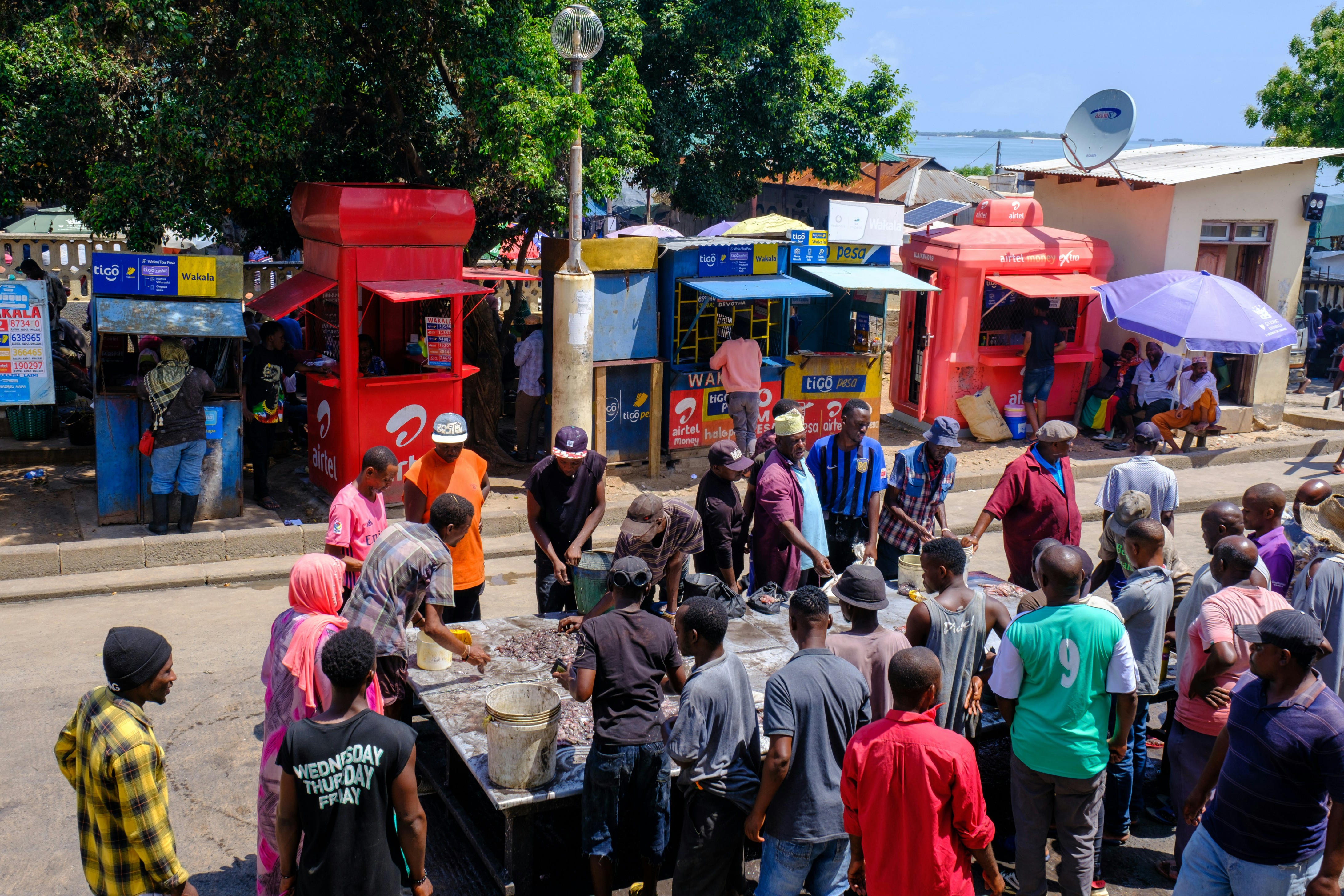
Before there was mobile money there was the bus.
A man working construction in Nairobi with a family in Kisii had a small number of options for getting money home, and the most common was to put cash in an envelope, find a matatu or long-distance bus heading the right way, pay the driver or conductor a cut, and hope. Sometimes he sent it with a relative travelling that weekend. Sometimes he used the post office. All of it was slow, all of it leaked, and a meaningful share of it simply never arrived. The demand for a way to send fifteen dollars two hundred miles was enormous, obvious, and completely unserved by the banking system, which had branches in the cities and roughly nothing in the villages, and which regarded a fifteen-dollar transfer as beneath its notice.
What became M-Pesa was not designed to solve that. It was designed as a microfinance repayment tool, funded in part by a British aid grant, so that borrowers could pay loan instalments by phone. During the pilot the Vodafone team noticed people using it for something else entirely. Customers were buying airtime and sending it to relatives, who sold it on for cash. They had improvised a remittance network out of a top-up feature.
Safaricom launched the product properly in March 2007 with a slogan that told you exactly which problem it had decided to solve: send money home.
Why it worked in Kenya, and not immediately anywhere else, comes down to four things that happened to line up.
Safaricom held something close to eighty per cent of the mobile market. That matters more than it sounds. A payment network is only useful if the person you want to pay is on it, and in Kenya, uniquely, one company's private closed loop was already nearly the whole country. The network effect did not have to be built. It was inherited.
The Central Bank of Kenya, presented with a telecoms company proposing to hold public money, did not have a legal framework for it, and chose not to wait until it did. It issued a letter of no objection and watched. Compare Nigeria, which took the more orthodox path of insisting mobile money be bank-led and keeping telcos out for years, and whose mobile money adoption consequently lagged for the better part of a decade despite having far more people.
Third, the agent network. Safaricom already had thousands of small shopkeepers selling airtime scratch cards, and turned them into cash-in and cash-out points. The hardest part of digital money in a cash economy is the physical edge, and Kenya's was already built and already trusted.
And then, in the first months of 2008, the post-election violence made moving physical cash across the country genuinely dangerous, at precisely the moment an alternative existed.
What followed is one of the few unambiguous technology success stories of the century. Within a handful of years a majority of Kenyan adults were using it. The model spread across the continent: MTN MoMo, Airtel Money, Tigo Pesa, EcoCash, Orange Money, Wave. Today Sub-Saharan Africa holds the largest share of the world's mobile money accounts and processes the largest share of global mobile money value. On domestic payments, Africa did not catch up with the rest of the world. It went past it.
Now hold that achievement next to the problem from Part IV, and watch it fail to touch it.
The thing that made M-Pesa work was a closed loop. Value inside M-Pesa is a line in Safaricom's ledger, backed by real money sitting in a trust account at a Kenyan bank, ring-fenced under Kenyan regulation. That is not a flaw. It is what makes the money safe, and every regulator on the continent requires some version of it. But it means a wallet balance is not portable. It is a claim on one company, in one country, denominated in one currency, redeemable through one licensed structure.
So the walls went up in every direction at once. Between operators inside a country, where for years sending to a rival network was expensive or impossible, and Kenya did not get full person-to-person interoperability until around 2018. And between countries, where the walls are far higher, because there the barrier is not commercial reluctance but law, licensing and foreign exchange.
Here is the detail that makes the point sharpest. MTN MoMo in Uganda and MTN MoMo in Rwanda share a brand, a parent company and a logo. They are, for payment purposes, two different institutions. Separate licence, separate regulator, separate trust account, separate ledger, separate currency. A shilling of Ugandan float cannot become a franc of Rwandan float by internal transfer, because that is an actual foreign exchange transaction and it needs an actual bank.
Which bank? Turn back to Part IV. The same chain. The same conversions, the same intermediaries, the same balance sheet in London or New York.
An aggregation layer developed to serve as a bandaid for this situation, and it does exist and work well. Websites such as Onafriq, Flutterwave, Interswitch, and many others constructed portals that allow access to many different wallets and only show a single interface to a business that wishes to send money internationally. However, the aggregator above correspondent bank foreign exchange still faces correspondent bank economics.
So both of these are true at the same time, and the tension between them is the whole state of African money as it stands today. Africa runs the most advanced retail payments infrastructure in the world by volume, adoption and everyday utility. And Africa remains the most expensive place on earth from which to pay your neighbour.
The revolution built brilliant rooms. Nobody built the doors.
Discussion
Comments
Comments go up straight away. Your email is never published — it is only used to tell you about replies.
Nobody has said anything yet. Go first.
Leave a comment