
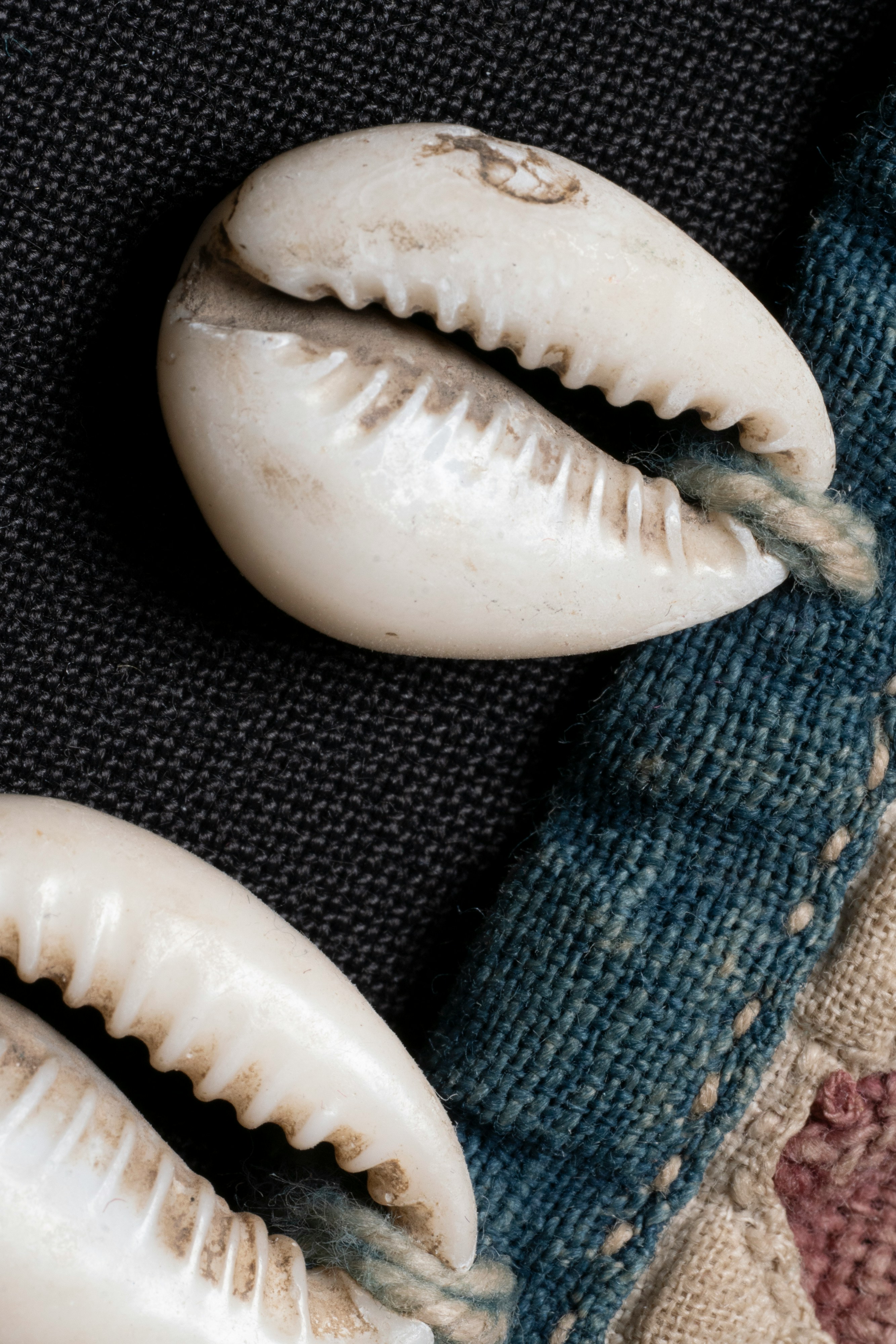
For centuries the cowries circulating in West Africa had been Monetaria moneta, the small money cowrie of the Maldives, shipped in modest quantities because the voyage was long and the shells were not free. Then in the 1840s European traders noticed a second species. Monetaria annulus, the ring cowrie, grew abundantly on the East African coast; it was larger and coarser than the Maldivian shell, and it could be bought at Zanzibar for almost nothing and carried around the Cape as ballast.
Hamburg and Liverpool firms began shipping it west by the ton.
Over the next three decades, more cowries arrived than West Africa had absorbed in the previous five hundred years. Shell prices climbed and kept climbing. Traders who had held wealth in cowries watched it thin out year after year, and by the 1890s the currency that had priced bridewealth, land, labour and tribute across a region of tens of millions was worth so little that people used shells for decoration and building aggregate. Nobody in Hamburg had set out to destroy a monetary system. They had found an arbitrage. The system was simply in the way.
This is the moment worth pausing on, because it establishes the pattern the rest of this article follows. Conquest did not do the damage. It was done by supply. And it left a vacuum, which colonial administrations were about to fill on their own terms.
Here is the mechanism, and it is more deliberate than the cowrie collapse was.
In 1898 the British Protectorate of Sierra Leone imposed a tax of five shillings on every dwelling. It was payable in British coin. Not in rice, not in palm oil, not in labour, not in shells: in coin, which almost nobody in the interior held, because almost nobody in the interior had any reason to hold it. The resistance that followed, led by the Temne chief Bai Bureh, took the British the better part of a year to put down. Eight years later Natal introduced a one-pound poll tax on unmarried men, and the rising it triggered ended with thousands of Zulu dead.
The tax was never really about revenue. Read the administrators' own correspondence and the purpose is stated plainly: a man who owes money in a currency he cannot grow, mine or make has exactly two ways to obtain it. He can go and work for wages at a European mine, plantation or railway. Or he can convert his land to a crop Europeans will buy for cash, such as cocoa, groundnuts, cotton, or palm.
The foreign-currency taxation system was a means of labour recruitment. It instantly produced both a labour force and an export economy, and it did so without any visible coercion of individuals. The coercion was buried in the unit of account itself.
Then came the elegant part, the piece most people have never heard of.
In 1912, Britain established the West African Currency Board. East Africa got its own in 1919. These bodies issued the money that Nigeria, the Gold Coast, Sierra Leone, Kenya, Uganda and Tanganyika used, and they operated on a rule of beautiful simplicity: every unit issued locally had to be fully backed by sterling held in London.
Follow what that rule does.
A colony could only get more money into circulation by earning sterling, and it could only earn sterling by exporting. So the Gold Coast's money supply was not set by what Gold Coast farmers, traders, or towns needed. It was set by how much cocoa Britain felt like buying. In a bad export year, the colony contracted whether it wanted to or not. There was no central bank, no discretionary monetary policy, no lender of last resort, no capacity to respond to a local shock. The currency was an accounting reflection of British demand.
Meanwhile, the reserves sat in London, invested in British government securities. Seigniorage, which is the profit a state ordinarily earns by issuing its own money, accrued to the boards and their reserves rather than to the territories using the currency. Africans held the notes. Britain held the assets and the interest they paid, and used African monetary reserves as a source of cheap sterling financing.
That is the colonial monetary settlement in one line: Africa supplied the demand for money, and Europe kept the balance sheet.
And then, remarkably, some of it never ended.
On 26 December 1945, the day France ratified the Bretton Woods agreements, Charles de Gaulle signed a decree creating the franc des Colonies Françaises d'Afrique. Eighty years later a version of it is still in use. Fourteen countries across West and Central Africa, together home to something like 180 million people, transact in a currency born of a French decree, pegged at a fixed rate to what is now the euro, and governed under arrangements France has been party to for its entire existence. Throughout most of its history, member countries have been required to make substantial deposits of their foreign exchange reserves in the French Treasury and to have French representatives sit on the governing bodies of the issuing central banks.
Reforms in 2019 and 2020 ended the reserve deposit requirement for the West African zone and withdrew French representation from its governance. The peg remains. The convertibility guarantee remains. The argument over whether it is a stabiliser or a leash is one of the most bitter live disputes in African political economy, and recent politics in the Sahel has sharpened it considerably.
Compare that to where we started. In the 3rd century, Aksum minted its own gold coins. In 2026, an entire group of African countries uses currency based on a monetary policy established in Frankfurt.
Independence was supposed to be the answer. Between 1957 and 1975, nearly every new African state issued its own currency, with its own name and its own faces on the notes. Almost all of them were in serious trouble within a generation.

Discussion
Comments
Comments go up straight away. Your email is never published — it is only used to tell you about replies.
Nobody has said anything yet. Go first.
Leave a comment