

I want to start with a receipt, because in payments the receipt is the argument.
Last month I needed RWF 14,000,000 in my bank account, and then in my hand. A year ago that sentence would have been the beginning of a bad afternoon. It would have meant queues at both ends, a deposit slip, and a fee schedule that scaled with the amount until it stopped feeling like a fee and started feeling like a tax on having money in the wrong place.
Here is what actually happened. It landed in two transfers, because eKash caps a single transfer at RWF 10 million. Twenty francs each.
Cost of moving fourteen million francs between two institutions: RWF 40. About three US cents.
Then I walked into the bank to withdraw it, and the counter charged me RWF 5,000.
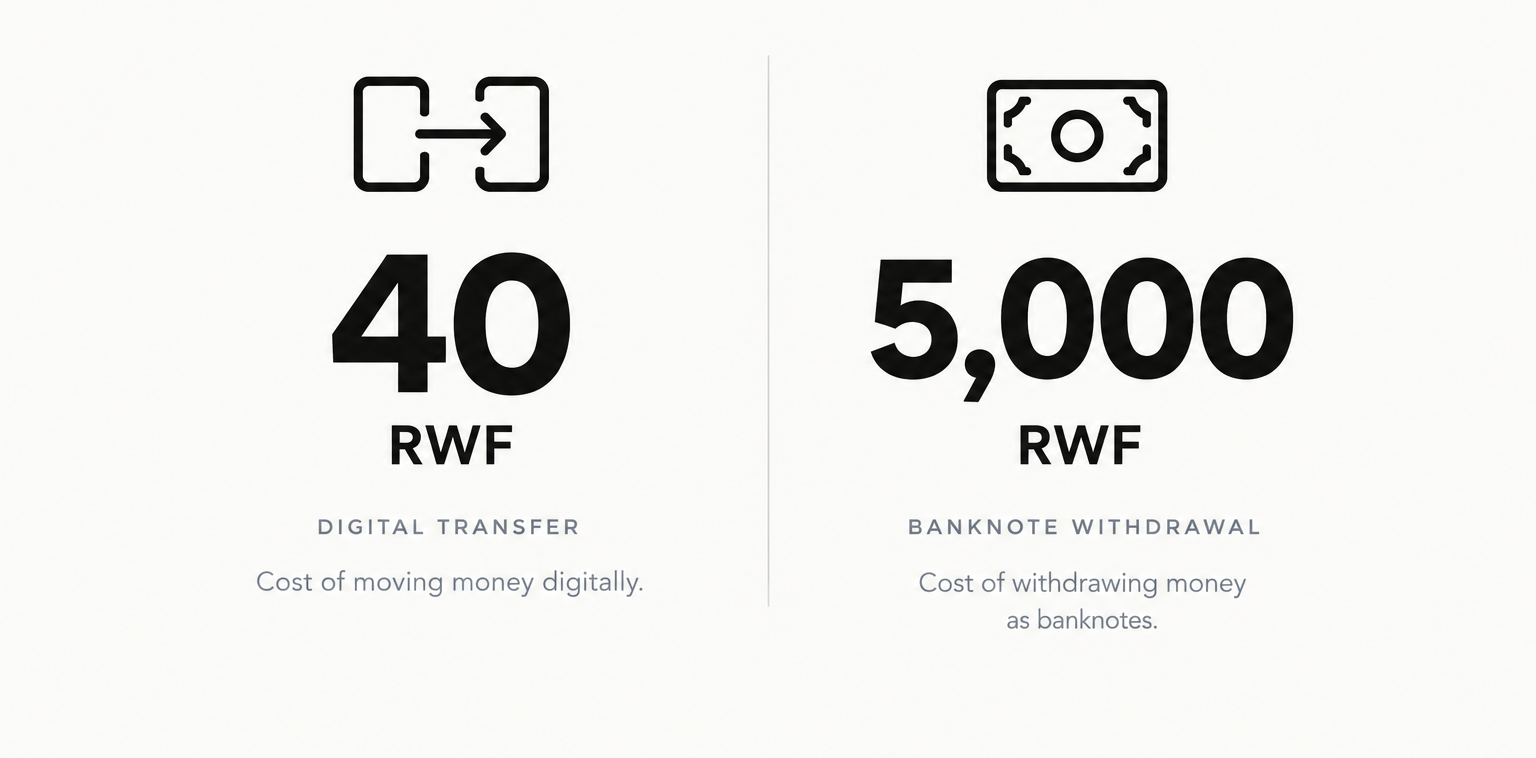
Sit with those two numbers next to each other, because the gap between them is the most interesting thing happening in Rwandan payments right now. Moving fourteen million francs digitally cost forty francs. Converting the same money into banknotes cost a hundred and twenty-five times more.
I have spent the last few years building payment infrastructure in this country. The first number still surprised me. The second one is the one worth writing about.
eKash is not an app. That's the whole point.
The most common misunderstanding I hear, including from people who work in fintech, is that eKash is something you download.
It isn't. eKash is the Rwanda National Digital Payment System, the rail sitting underneath the apps you already use. Your bank app, your USSD code, your MoMo menu, your internet banking login. Nobody registered for anything. On 14 July 2026, the plumbing changed and most people found out because their transfer got cheaper.
The mechanics, briefly:
• Every domestic interoperable retail transfer between banks and e-money issuers now routes through one national switch, operated by RSwitch under National Bank of Rwanda supervision.
• Four directions are covered: account to account, account to wallet, wallet to account, wallet to wallet.
• The customer fee is capped at RWF 20 per transfer. Institutions can charge less, or nothing.
• Per-transaction ceiling is RWF 10 million, with no daily cap.
• Merchant payments carry no eKash charge at all, for the customer or the merchant.
That last line deserves more attention than it has been getting, and I'll come back to it.
The instrument behind all of this is NBR Directive No. 45/2026, issued on 9 January 2026 and effective 14 July. Six months' notice, then a hard switch. Governor Soraya Hakuziyaremye signed the public notice.
The version of Rwanda this was designed to fix
To understand why RWF 40 felt like a small miracle, you have to remember the thing it replaced.
In 2018 Rwanda published its National Payment System Strategy, subtitled Towards a cashless Rwanda. It was a joint BNR and MINECOFIN document with five pillars and one honest premise: digital payments existed, but they didn't connect. Every bank and every mobile money operator maintained its own bilateral integrations with everyone else. Interoperability was a series of private treaties, and private treaties are expensive to negotiate and easy to under-invest in.
What that meant on the ground was the cash-out dance. If money sat in your MoMo wallet and the person you owed was on Airtel Money, the fastest route between two digital balances went through physical banknotes. You withdrew at one agent, walked, and deposited at another. You paid at both ends. Merchants had it worse: a customer standing in front of you, ready to pay, unable to, because the code on your counter belonged to the wrong network. Shopkeepers in this country lost sales to a technical incompatibility.
So Rwanda built the rail. And it built it in a specific way that matters more than the launch-day headlines suggested.
RSwitch built eKash in-house, on Mojaloop, the open-source instant payments stack. Not a licensed proprietary switch from a vendor. AfricaNenda provided technical assistance, RISA provided strategic oversight, Access to Finance Rwanda, the Gates Foundation, GIZ and the Mojaloop community all showed up. But the system is locally owned, the code is open, and the standards are Rwanda's to change.
That is a sovereignty decision dressed up as a procurement decision. Rwanda's Minister of ICT and Innovation, Paula Ingabire, put the commercial logic plainly at the national launch: interoperability unlocks innovation, and it lets fintechs and businesses reach more customers.
The rollout came in stages, not one leap. RNDPS 1.0 in 2022. The upgraded Mojaloop platform and the merchant payment use case in February 2025. A national launch ceremony at the Kigali Convention Centre in December 2025. Then the mandatory migration this July.
The receipts, at national scale
Three weeks after the switch, BNR published numbers. I've watched enough launches to be sceptical of week-one metrics, but these are worth reading:
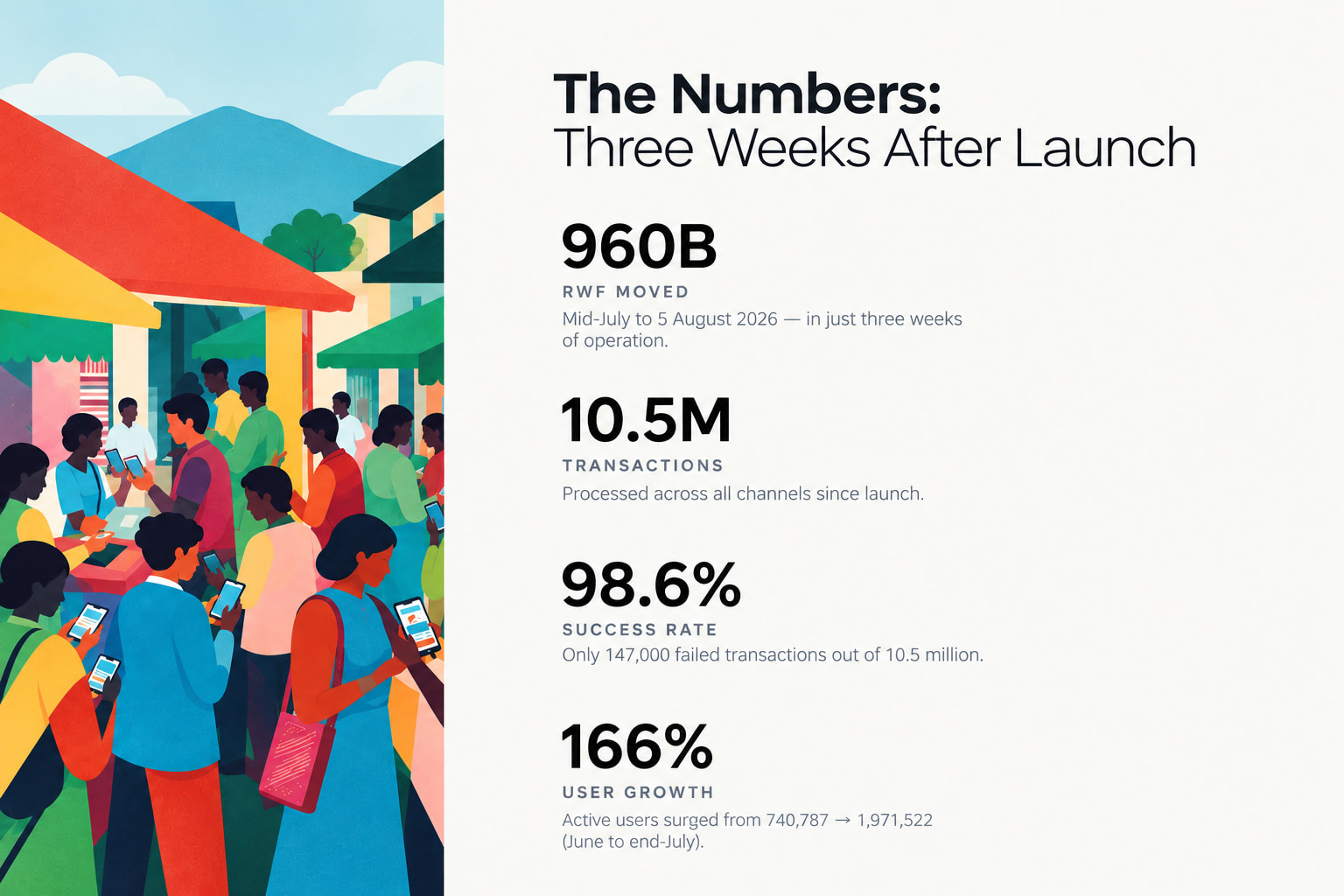
Some longer-run context. This did not come from nowhere. A year before the mandate, eKash was already live across 20 institutions, and NBR reported transaction value up 301% year on year in August 2025. Over the same period, the total value of retail electronic payments moved from 265% to 316% of GDP, a ratio that runs above 100% because the same franc is counted each time it changes hands.
And the base this landed on is unusual. FinScope 2024 put financial inclusion at 96% of adults, roughly 7.8 million people, up from 48% in 2008. Formal inclusion hit 92%. But look at the split: about 68.5% of adults hold an electronic wallet and roughly 5% hold a bank account.
That asymmetry is the entire story. Rwanda didn't need to connect banks to banks. It needed to connect the 68.5% to the 5%, cheaply, both directions, instantly. Which is precisely the transfer I made.
The parts that are still hard
I'd rather say this than have someone else say it for me.
The rollout was not smooth: In the first weeks, customers at Ecobank, BPR and I&M reported failed transfers, dead USSD codes, and PIN prompts nobody could interpret. The New Times ran the complaints. A fair amount of that friction was inherited from individual banks' cutover to the new flow rather than the switch itself, but the customer doesn't care whose fault it is. A 98.6% success rate is strong. It also means roughly 147,000 failed transactions in three weeks, and each one belonged to someone.
The flat fee has a regressivity problem: RWF 20 on ten million is a rounding error. RWF 20 on a RWF 500 transfer is four percent. Richard Kwizera made this point publicly and it landed, because it's correct: a flat fee is proportionally heaviest on the smallest, most frequent, most financially fragile transactions. The counterargument is that predictability has real value and RWF 20 still undercuts almost every prior tariff. Both things are true. The interesting question is whether institutions use the headroom the directive gives them, since they are explicitly free to charge less or zero.
Somebody's revenue just disappeared: Transfer fees were a line item for banks and mobile money operators, and that line item has been compressed to almost nothing by regulation. That capital has to be redeployed into products rather than tolls. The Rwanda Bankers' Association has been notably upbeat about this framing. Not everyone will execute it well. There is already reporting suggesting interoperability hasn't translated into growth for Airtel Money, and if one operator's agent network weakens, rural users feel it first. Interoperability is not the same thing as competition.
The last mile to cash is now the expensive part, by a wide margin: The directive capped interoperable transfers. It did nothing to cash-out pricing, at agents or at bank counters. So the journey from digital to physical, the leg that still matters most in a largely cash economy, is now the costliest step in the chain.
My own transaction is the cleanest illustration I have. Forty francs to move the money. Five thousand to turn it into paper. The rail got cheap; the exit did not. For anyone whose rent, wages or stock purchases are settled in cash, the headline reform has only reached part of their week.
What's coming, and why the Tanzania link is the one to watch
RSwitch's published roadmap: bulk payments, QR-code merchant payments, government-to-person disbursements, SACCO and MFI onboarding, and then cross-border instant payments.
The first four are useful. The fifth changes the map.
Rwanda and Tanzania are running a proof of concept to interlink Tanzania's Instant Payment System with RSwitch. Technical teams met in Kigali in November 2025 and again in Zanzibar in July 2026, working through governance, business rules and risk frameworks. It sits under the EAC Cross-Border Payments System Masterplan, financed through the Eastern Africa Regional Digital Integration Project with World Bank and GIZ support.
It's still a proof of concept. No go-live date. But it's the EAC's flagship pilot, and the design intent is that if Rwanda–Tanzania works, the template extends to every other partner state.
Also relevant, and underdiscussed: Rwanda's National Financial Inclusion Roadmap 2026–2030 names NBR and RSwitch jointly responsible for facilitating fintech integration into the national payments infrastructure. The roadmap doesn't publish the access model or the criteria yet. For anyone building payment products in this market, that's the single most consequential unwritten document in the country.
If the rest of the continent copies this
Rwanda isn't alone, and that's the point.
AfricaNenda's SIIPS 2025 report counts 36 live instant payment systems across 31 African countries. Together they processed 64 billion transactions worth nearly two trillion dollars in 2024, with volumes compounding at about 35% a year since 2020. Nigeria's NIP became the first African system to reach the top tier of AfricaNenda's inclusivity spectrum. Liberia stood up a national system in 73 days.
Now imagine what Rwanda has, replicated. Open-source code, locally owned, near-zero domestic transfer cost, and then interlinked across borders.
Here's the honest accounting of what that does to cross-border payments, because the hype usually gets this wrong. Sending money into or within Africa is expensive for five separate reasons:
1. Domestic collection on the send side
2. FX spread
3. Liquidity and pre-funding across currencies
4. Compliance, licensing and settlement overhead
5. Last-mile payout on the receive side
A continent of eKash-style rails crushes items 1 and 5. It does essentially nothing to items 2, 3 and 4.
That is still enormous. Sub-Saharan Africa remains the world's most expensive region to send money to, and the SDG target of 3% is not close for most African corridors. Compressing the two ends compresses real cost. But anyone claiming that instant payment rails alone solve cross-border is selling something. FX, float and compliance don't get cheaper because a switch got faster. They get cheaper because someone does the unglamorous work of holding liquidity in the right places and staying licensed in the right jurisdictions.
Which is, roughly, our job description.
Where InversePay sits in this
We build cross-border payments and multi-currency wallet infrastructure: a consumer app that moves money into Africa, out of it and across it, and a business product for collections, payouts, USD and EUR account details and multi-currency balances. Payouts reach banks and mobile wallets across 158 countries. Rwanda is where we build from.
So what does eKash actually change for us?
First, it settles an argument we no longer have to win: We spent a long time explaining to partners and investors that Rwanda's domestic rails were fragmented and expensive. They aren't any more. The domestic leg of a cross-border transfer into Rwanda is now, in principle, one of the cheapest in Africa. That makes this corridor materially more attractive to build into, and it makes Rwanda a genuinely credible base from which to build outward.
Second, and this is the part most people get wrong: RWF 20 is a consumer ceiling, not a wholesale price: Directive 45/2026 governs what a bank or e-money issuer may charge a customer for an interoperable transfer. It does not set what a payment company pays an aggregator for API-initiated mobile money collections or disbursements. Those are commercial arrangements, and in this market they still run as percentage-based collection rates and flat per-transaction payout fees well above twenty francs. The gap between the consumer ceiling and the wholesale cost is made of aggregator margin, operator API pricing, pre-funding, reconciliation and support.
That gap is a real number, and closing it is where the work is. Every franc of it currently sits between a diaspora sender in Brussels and a grandmother in Nyamagabe.
Third, the merchant leg is free, and almost nobody is talking about what that unlocks: Merchant payments over eKash carry no transaction charge for either side, and one merchant code now accepts MTN MoMo, Airtel Money and bank payments alike. Domestic acceptance in Rwanda is, for practical purposes, solved.
Now hold that next to who is arriving. Since January 2018, Rwanda has granted visa on arrival to every nationality on earth, with the fee waived outright for African Union, Commonwealth and Francophonie citizens, and EAC nationals entering on a national ID. In 2025 that openness helped deliver 1.49 million visitor arrivals and USD 685 million in tourism receipts, including 61,888 delegates across 165 international events, according to RDB.
So picture the delegate. She lands at Kigali International for a summit at the convention centre, and by evening she's in a restaurant in Kiyovu. The code on that counter will accept money from any bank or any wallet in Rwanda, instantly, for free. It will not accept anything from the account her salary is paid into.
That's the gap. Rwanda made it effortless for the person to arrive, and effortless for money to move once it's here. What's still missing is the bridge between those two facts, and that bridge is a cross-border problem, not a domestic one. The same is true in reverse for the Rwandan business that wants to invoice a customer in Lagos or Lisbon and currently can't take the payment without losing days and a percentage.
And fourth, the strategic one: If the Rwanda–Tanzania interlink works and the EAC template extends, the durable advantage in this market belongs to whoever is authorised in multiple East African jurisdictions, holding liquidity in each, and connected to each national rail. That combination is very hard to replicate quickly. Not because the technology is hard. Because permissions, float and regulatory relationships take years and cannot be bought in a sprint.
That is where our energy goes. It is the least exciting work in this company and the most valuable.
We start with the corridors we know, because liquidity and permissions are won one market at a time and there is no shortcut. But the logic doesn't stop at a corridor. Once a country's acceptance layer is free and universal, the only variable left in the equation is where the payer's money happens to start. That question has exactly the same shape whether the sender is in Brussels, Lagos, Dubai or Toronto. Corridors are where you begin. Any sender, any business, is where it goes.
The thing worth remembering
A country decided that moving your own money between two institutions should cost about a cent. It published the directive in January, gave the industry six months, switched the rail in July, and published performance data three weeks later, including the failures.
Fourteen million francs. Two transfers. Forty francs. And then five thousand francs to hold it in my hand.
The first number is what a decision looks like. The second is what's left to decide.
— Adrian Mukembo